
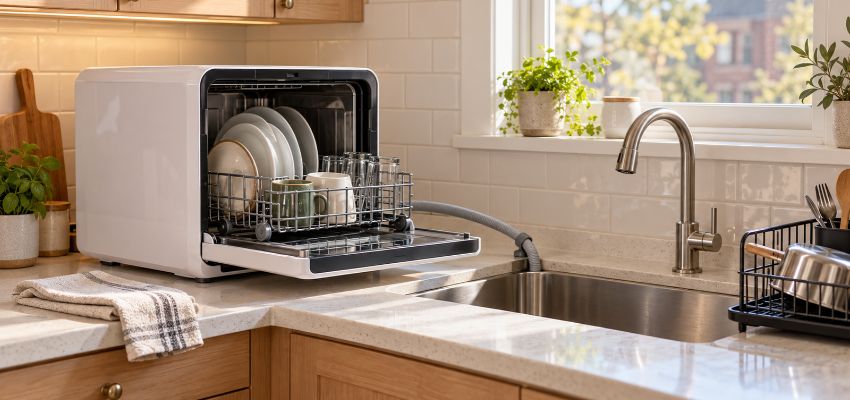
Choose a countertop dishwasher when you have a practical place to operate it, a rolling model when you have parking and a clear route to the sink, or a compact built-in when permanent installation is possible.
The right small dishwasher setup should take a useful share of washing off your hands without making the rest of the kitchen harder to use. That depends on your dishes, water connections, available space, and the tasks you are comfortable repeating.
Start with an ordinary day’s dirty dishes. Then work through the space and water checks below before comparing models. A machine can wash well and still be the wrong fit for your home.
Start with the Dishes You Want to Stop Washing
-
Identify the pile you want help with
Look at the plates, bowls, mugs, utensils, food containers, and cookware from an ordinary day. Notice whether the burden comes from many small pieces, bulky cooking items, or both.
-
Separate suitable items from hand-wash items
Check the care instructions for the things you use most. A machine cannot take over washing an item that is unsuitable for dishwashers, even when it fits inside.
-
Decide what counts as a useful load
Think about how much you want washed between meals or before the next day. Decide whether smaller repeated loads would be manageable or would leave you continually loading and unloading.
For example, two people who mainly need help with cups, plates, and utensils have a different problem from two people who cook several dishes every evening.
Household size alone cannot tell you how much washing a small machine will remove. Make a short list of the items you most want it to handle; those become your buying checks.
Choose Countertop, Rolling, or Built-In Around Your Space
Product listings sometimes use “portable” for both countertop machines and larger units on wheels. Check the actual format. Each uses kitchen space differently, so the smallest-looking appliance is not automatically the easiest one to live with.
Choose Countertop When You Have a Usable Spot
A countertop model is a candidate when a stable, suitable surface, an appropriate outlet, and the required water arrangements are available together. Count the space needed to open the door and handle dishes, not just the space occupied by the closed machine.
Also decide whether the machine can stay there. A countertop dishwasher may be inconvenient to lift in and out of storage. If your plan depends on putting it away after every wash, check its weight and how you would handle the hoses before treating that as a workable routine.
Choose Rolling When You Have Parking and a Clear Route
A rolling dishwasher may suit a larger everyday load when permanent installation is not possible. It needs a place to stand between washes and somewhere to operate near the required water connection. Those may be two different locations.
The countertop or rolling choice therefore involves both working space and storage space. Walk the route from parking spot to sink, then picture the door open and the racks pulled out.
Check that the machine will not block the only passage through the kitchen. Include the effort of moving and connecting it in your decision.
Choose Compact Built-In When Permanent Installation Is Possible
A compact built-in is worth investigating when you have a suitable opening or can arrange an approved installation. It uses cabinet space while keeping a separate appliance off the counter and out of the walkway.
The opening, plumbing, electrical connection, and door clearance all need to meet the selected model’s installation requirements.
The portable or built-in decision is partly about what your home allows. In a rental, confirm permission for permanent changes before planning them.
If a suitable built-in location already exists, compare that option before assuming a countertop machine will make better use of a small kitchen.
Check Water In and Wastewater Out Separately
“No permanent plumbing required” still leaves two practical questions: how does clean water enter, and where does dirty water go? A built-in fresh-water tank answers only the first question.
Choose Tank or Faucet by the Task You Prefer
With a tank-fed model, picture carrying the fill container and pouring water into the opening. Check where that opening is and whether upper cabinets leave room for filling. If reaching or lifting is uncomfortable, this matters as much as the machine’s footprint.
A faucet-fed model removes the repeated filling task but needs a compatible connection. Verify the dishwasher adapter against your exact faucet, particularly a pull-out or pull-down design, with the relevant manufacturers.
Do not assume that an adapter advertised as universal establishes compatibility.
Choosing tank or faucet is also a choice about how you use the sink during a cycle. A hose attached to the main spout can interrupt normal faucet use.
Tank filling may suit someone who wants that spout available; connecting to a suitable faucet may suit someone who would rather avoid pouring water. Neither preference is a fault to design around.
Give Wastewater a Suitable Route
Identify the drain arrangement before selecting a location. For example, HAVA’s R01 guidance describes draining through a supplied hose into a sink or suitable container. That fresh-water-tank model still needs somewhere for wastewater to go.
Check the model’s permitted drain height, hose routing, and method of securing the outlet. A hose that reaches the sink is not enough if it cannot be installed as directed.
A container arrangement, when permitted, adds checking, carrying, and emptying to the routine. Other designs may have a separate wastewater tank; establish what the particular machine actually provides.
Faucet-fed machines have their own connection and draining routine. Whirlpool’s operating instructions describe supply and discharge hoses, including checking for kinks. Follow the selected model’s instructions rather than improvising a permanent connection from a temporary hookup.
Measure for Opening, Filling, and Loading
-
Mark the closed machine and rear connections
Use product dimensions, not shipping-box dimensions. Mark the footprint with removable tape and include the installation clearance needed for hoses, ventilation, and connections.
-
Allow for the open door and extended rack
Check how far the door projects. Picture standing in front of it, sliding the rack out, and loading a plate without reaching across an obstacle.
-
Check the filling space above or beside it
For a manually filled tank, allow room for your hand and fill container. A machine that fits beneath a cabinet may still be awkward to fill there.
-
Confirm the outlet and cord arrangement
Check the electrical requirements and cord reach in the manual. Do not plan around an extension cord unless the manufacturer expressly permits it.
-
Test the motions of an ordinary wash
Use a cardboard size mock-up if helpful. Walk through scraping, loading, adding detergent, starting, and unloading. This checks the location and your access; it does not establish wash performance or structural suitability.
Leave the marked area occupied while you prepare a meal. You may discover that the proposed spot is also where you set down a hot pan, chop vegetables, or unload groceries. Find a realistic alternative for that task before counting the location as available.
Check Your Largest Everyday Items Before Place Settings
-
Match plate diameter and bowl depth
Measure the dinner plate and deep bowl you use most. Compare them with the model’s stated limits and loading illustrations, including whether a large plate must be angled.
-
Check height and awkward shapes
Look at tall mugs, food-container lids, handles, and utensils. A rack may have enough room overall but unsuitable spacing for the things you repeatedly wash.
-
Allow water and spray arms to reach the load
An item being inside the door does not mean it is properly loaded. Follow the instructions for spacing, orientation, and keeping spray arms unobstructed.
Place-setting numbers are useful for an initial comparison, but they cannot describe your complete daily load.
As a hypothetical example, a machine might accommodate breakfast plates and mugs yet leave no room for the saucepan from the same meal. That may still be worthwhile if those small items are the work you most want removed.
Look for interior photographs and loading diagrams, not just the closed front view. Ask the manufacturer about an important item when the fit is unclear. The more your purchase depends on washing one particular pot or bowl, the less useful a general claim such as “ideal for two people” becomes.
Keep Room for What the Machine Leaves Behind
- Hand-wash items still need a place Keep access to the sink for unsuitable or oversized items. A small dishwasher can reduce the pile without replacing the rest of the washing routine.
- Clean does not always mean ready to put away Drying varies by model, program, material, and loading. Allow a practical way to handle residual moisture without rebuilding a full drying station after every cycle.
- Displaced work needs another home Identify whether the machine replaces a drying rack, a preparation area, or another appliance. Count where that previous activity will move.
If you wash with one sink, picture how the remaining cookware will move through it while the dishwasher is connected or draining.
Keep the prescribed drain outlet clear. A setup that removes plates from the sink but blocks the place needed to rinse a pan may need a different location or wash schedule.
A small-counter drying rack can provide a home for the remaining hand-wash items, but choose its footprint after accounting for the machine and open door.
The goal is a workable washing area, not two space-saving products competing for the same patch of counter.
In The Kitchn’s three-year account, the writer accepted a machine occupying the counter because a drying rack had already used that space and food prep happened elsewhere.
That is one household’s workable trade-off. Your own check is whether the displaced activity has somewhere equally practical to go.
Choose the Setup That Removes More Work Than It Adds
- Hands-on work
The actions you must perform: scraping, loading, filling or connecting, unloading, cleaning the filter, and handling anything left for hand washing.
- Elapsed time
The time until dishes are available again, including washing and drying. A long cycle can still reduce your hands-on work, but may be inconvenient when you need those same dishes for the next meal.
- Repeated hand washing of suitable plates, cups, and utensils.
- Some of the time spent standing at the sink.
- Part of the daily pile waiting to be washed.
- Filling a tank or attaching and disconnecting hoses.
- Dividing the dishes into loads and finding space for leftovers.
- Moving the machine, cleaning the filter, and dealing with wet items.
Whether a countertop dishwasher is worthwhile depends on which side matters more in your kitchen. If washing many small pieces is exhausting, taking that task away can be valuable even when setup takes a few minutes.
If the machine needs frequent moving and still leaves your main cooking items for hand washing, another format may be a better candidate.
The trade-off can remain mixed. In a two-week Epicurious trial, the reviewer found the machine useful but wanted the counter space back, while her partner would miss it. The useful lesson is to identify the inconvenience you personally want reduced before paying for a different one.
Before comparing prices, describe one ordinary wash from start to finish. Where do dirty dishes wait? Who fills or connects the machine? When are the clean dishes needed? Who empties a wastewater container if one is used?
A setup that works only when someone makes an extra effort every day is worth reconsidering now.
Start with a typical load and the items you most want help washing. Identify a location that works with the door open, confirm both water supply and wastewater disposal, and keep room for the washing the machine cannot take over.
Then eliminate formats that fail those checks. Compare models within the remaining practical options. You do not need the smallest dishwasher on the market; you need a setup that makes the next ordinary meal easier to clear away.
