
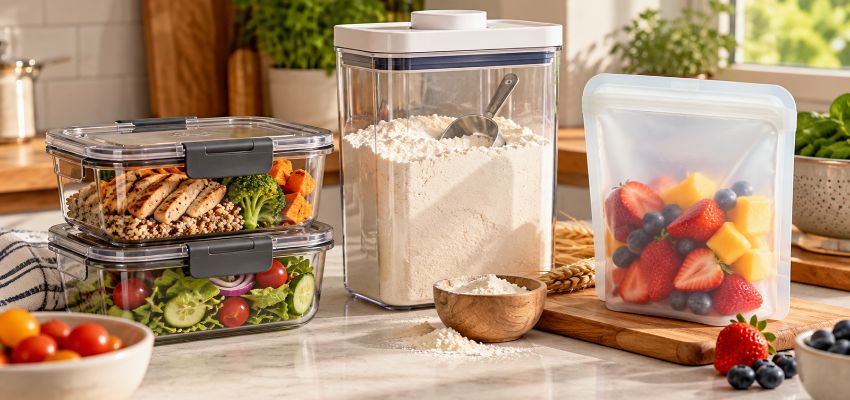
A cupboard full of matching containers can still leave you without the one you need.
There is leftover pasta to refrigerate, a serving of soup to take to work, an open bag of flour on the pantry shelf, and a few portions waiting for freezer space. They are all storage jobs, but they do not call for the same container.
The useful question is not how many pieces come in a set. It is which everyday jobs your current containers cannot handle well. Start with those gaps, then choose the capacity, shape, material, and lid that solve them. Specialty storage can wait until you have a recurring reason for it.
Start With the Food You Store Most Often, Not a Matching Container Set
Look at a normal week before looking at a container set. Which food is repeatedly left without a suitable home? A refrigerator full of leftovers calls for different shapes than a pantry full of opened baking ingredients.
And a container that stays upright on a shelf may not be the right one for a lunch bag that tips over.
| Recurring job | What matters first | Do you need a dedicated container? |
|---|---|---|
| Refrigerating leftovers | Portion fit, stackability, an easy lid | Usually a few versatile sizes are enough. |
| Packing lunch | Weight and a closure suited to travel | Only if your fridge containers are awkward or prone to spills. |
| Storing flour or sugar | Opening width, dry storage, shelf height | Only if the original bag is inconvenient or inadequate. |
| Freezing batches | Freezer suitability, headspace, efficient portions | Use freezer-rated boxes or bags suited to the food. |
| Keeping produce or snacks | Moisture management or flexible packing | Try specialty storage only when a problem repeats. |
Mark each job as frequent, occasional, or already handled. That simple distinction prevents a large set from becoming a cupboard of rarely used pieces. If three lunches compete for one dependable container every week, another lunch-sized box may help more than six pantry canisters.
Choose Everyday Leftover Containers by Portion Size, Shape, and Reheating Habits
Keep Small Extras, Single Meals, and Shared Leftovers in Different Sizes
One deep box is a poor home for two tablespoons of dressing; a row of tiny tubs is equally frustrating for a family-sized portion of rice.
A useful starting mix includes a few small containers for sauces, several meal-sized ones, and one or two larger boxes for shared leftovers. These are roles, not a shopping quota. Your actual portions should determine the sizes.
For example, if a typical lunch fills only the bottom of a large box, you gain little from its advertised capacity while surrendering fridge space. Try serving an ordinary meal into a bowl, then compare that amount with the usable space inside a container.
Choosing meal-prep container sizes around your usual portions is more reliable than assuming every lunch needs the same volume.
Choose Glass or Plastic by How You Carry, Reheat, and Wash Food
Glass is useful when you want a rigid, transparent container and prefer to reheat food in a glass base that is labeled for that purpose. Its weight and bulk can be drawbacks in a work bag or crowded cabinet.
Plastic is lighter and may nest more compactly, but some pieces can retain stains or odors, and heat-use instructions vary by product. Neither material is automatically safe for every microwave, freezer, or dishwasher.
Think through the entire routine: will the food stay at home, be carried on a commute, or move from fridge to microwave?
The trade-offs between glass and plastic containers for everyday leftovers become clearer when the same meal is considered across all three situations.

Round or Rectangular? Measure the Shelf Before Choosing a Shape
Rectangular bases can line up against straight fridge walls and leave fewer awkward gaps between boxes.
Round containers can be pleasant for stirring sauces or serving soup, but a row of circles does not fill a rectangular shelf edge to edge. The trade-off also depends on whether containers stack securely when full and nest when empty.
If your main frustration is wasted shelf space rather than insufficient capacity, comparing round and rectangular food storage containers for space efficiency can help you choose a shape before buying more of the same volume.
Give Flour and Sugar Their Own Containers Only When Packaging Gets in Your Way
A dry-goods container earns its space when an open bag spills, tears, attracts moisture, or makes scooping difficult. Flour used every week is a different case from a rarely opened bag of specialty grain. You do not need to decant every pantry item just to make the shelves look uniform.
Allow Space for a Scoop, Not Just Enough Capacity for the Bag
A container can technically hold a full bag of flour yet be unpleasant to use if the contents reach the rim. The opening must admit a scoop, and there needs to be space to lift it without scattering flour.
Measure the shelf with the lid attached, then check that the container can be lifted out without scraping the cupboard above.
Because ingredient density, settling, and fill lines vary, the container capacity needed for a five-pound bag of flour deserves its own calculation rather than a universal quart recommendation.
Choose a Seal You Will Actually Close Every Time
A tight-fitting lid is useful for dry staples, but an elaborate closure is not automatically more practical. Consider whether the seal is easy to operate with floury hands, whether the gasket can be cleaned, and whether the lid can be replaced.
An airtight claim for pantry storage is not the same thing as a leakproof claim for a tipped lunch container.
For frequently opened flour and sugar, the features that matter in airtight pantry-container lids include both the seal and how reliably you can use it day after day.

Freeze Food Without Wasting Space or Using the Wrong Container
Freezer storage has two competing demands: food needs protection, but empty air and bulky packaging consume valuable space. Choose a freezer-rated container or bag that fits the portion and the food’s texture.
For liquids, leave the headspace specified by the container maker because the contents expand as they freeze.
Choose a Rigid Box When Food Needs Support
A rigid box helps protect soft leftovers from being crushed under other frozen items. It can also keep soups and sauces upright while they freeze, provided the base and lid are intended for freezer use. The downside is fixed volume: a half-filled box still takes up its full footprint.
Choose a Freezer Bag When Flat, Flexible Portions Save More Space
Bags can be useful for cooked grains, chopped ingredients, and other portions that can freeze flat. Press out excess air according to the bag’s instructions, seal securely, and support liquid-filled bags on a tray until solid. A flexible bag saves room but offers less protection against crushing or punctures.
The choice between freezer bags and rigid containers for leftovers is therefore less about which format is universally better and more about whether space or structure matters for the food you are storing.
Treat Freezer-Safe Glass as a Specific Product Claim
Not all glass food containers are designed for freezing, and a freezer-safe base does not make its lid oven-safe. Follow the maker’s fill guidance, especially with soups and sauces, and avoid abrupt temperature changes.
Do not put hot glass straight into a freezer or move frozen glass directly into a hot oven unless the manufacturer explicitly allows that sequence.
For liquid portions and temperature changes, freezing food in glass containers without breaking them requires more careful handling than a generic freezer-safe label might suggest.
Use the manufacturer’s freezer, microwave, oven, and lid instructions for the exact model. Leave appropriate expansion room for liquids, and never assume that a glass base and its plastic lid share the same temperature limits.
Skip Specialty Containers Until a Recurring Problem Makes Them Useful
Specialty storage makes sense when a recurring problem has survived simpler fixes. If berries are regularly crushed under other groceries, or flexible snack packing would free up space in a crowded bag, a specialized shape might help. If those problems rarely occur, ordinary containers are often sufficient.
Produce Boxes Can Be Useful for Delicate Food, but They Occupy Fixed Fridge Space
Some produce containers use raised inserts or vents to separate delicate food from pooled moisture. That design may suit certain routines, but it adds pieces to wash and takes up a predictable amount of shelf space whether full or empty.
Different produce also needs different handling; no single box guarantees longer freshness.
Before buying, compare your existing washing, drying, and storage routine with whether produce storage containers are worthwhile for berries and leafy greens. If the produce is eaten quickly and stores well already, the extra box may add more work than value.
Silicone Bags Trade Rigid Protection for Flexible Packing
A reusable silicone bag can tuck into an awkward gap around lunch items or hold a small snack without the fixed shape of a box.
The trade-off is practical: filling a soft bag, cleaning its corners, and drying the opening may be less convenient than using a simple rigid container. Stand-up designs address part of the filling problem, but they still need storage and cleaning space.
That makes the everyday value of silicone bags for snacks and leftovers a question about your routine, not about replacing every disposable bag in the house.

Check the Lid, the Shelf, and the Empty Stack Before Buying More
Before adding a container to your cart, follow its whole journey through the kitchen. It must fit the food, close reliably, occupy a sensible spot while full, survive the cleaning method you use, and have somewhere to go when empty.
A clever lid is not helpful if it takes two hands and several attempts to align.
Four details that decide whether a container gets used
-
A lid matched to the actual job
Dry pantry storage, upright refrigerator storage, and a lunch bag carried sideways are different demands. Check the specific manufacturer’s closure claims.
Look forA closure you can operate and verify consistently.AvoidTreating airtight, leak-resistant, and leakproof as synonyms. -
A footprint that fits your shelf
Measure with the lid attached and leave room to lift the box out.
Look forA shape that fits the real fridge or pantry space.AvoidChoosing by capacity alone. -
A workable stack when full and empty
Stable stacking and compact nesting are different features. Check where the lids will go too.
Look forStable full stacks and manageable empty storage.AvoidBuying a set that becomes a pile of unmatched lids. -
Cleaning and replacement that fit your routine
Inspect gaskets, grooves, and manufacturer care directions. Cosmetic discoloration is not the same as a cracked rim or a warped lid.
Look forAccessible surfaces and a lid that continues to seal.AvoidKeeping damaged closures for liquids in transit.
A simple test is to imagine using the container five times: filling it, placing it on the shelf, retrieving it, reheating only if approved, washing it, and putting it away empty. If one of those steps is consistently inconvenient, a different design may matter more than an extra piece in the set.
Count the jobs that need a container during an ordinary week: leftover meals, packed lunches, freezer portions, and open dry ingredients. Then notice which job runs short of a suitable size or closure. Fill that gap first instead of buying a large matching set by default.
For most kitchens, versatile everyday containers come before specialty boxes and bags. A new container earns its place when it makes a recurring task easier—not simply because there is room for one more in the cupboard.
