
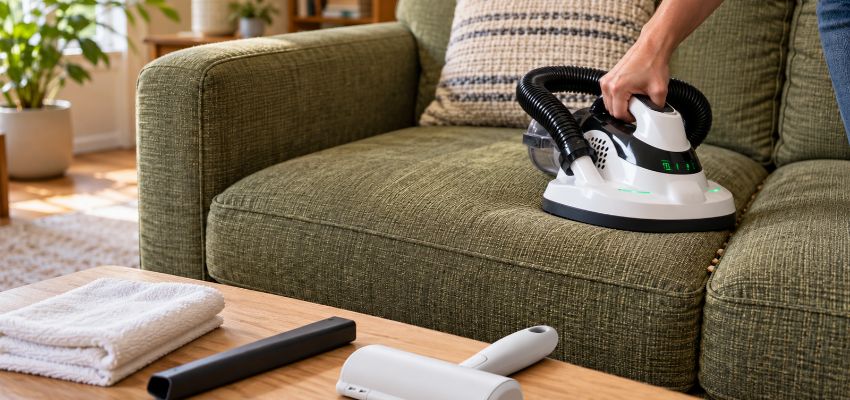
Crumbs, clinging hair, and a coffee spill need different tools – not necessarily a new machine.
The couch cleaning tools to start with are usually a vacuum with suitable upholstery and crevice attachments, plus clean white absorbent cloths. Add a pet-hair remover when hair remains caught in the fabric. Choose a cleaning product or machine only after checking what the couch’s care instructions allow.
This guide focuses on fabric upholstery. Leather, suede leather, and other specialty finishes need their own care guidance. Even among fabric couches, a washable slipcover and a fixed cushion marked for solvent cleaning call for different supplies.
Look at the mess before looking at the equipment. Loose crumbs need collecting, hair may need lifting from the fibers, and a liquid mark needs an approved treatment. One tool rarely handles all three jobs equally well.
- An upholstery attachment Use a fabric-appropriate head for the broad surfaces of cushions, arms, and the backrest. Check the couch and vacuum instructions before using rotating brushes.
- A crevice attachment Choose a narrow tip for accessible cushion gaps and seams. It should reach the debris without forcing the fabric or pulling at fixed cushions.
- Clean white absorbent cloths Keep cloths available for blotting permitted spills and for approved spot treatment. White, colorfast cloths make transferred soil or fabric dye easier to notice.
Check the accessories that came with your vacuum before buying replacements. A suitable hose and two useful heads may already cover routine couch cleaning. A soft brush is an optional addition when the fabric permits brushing; a stiff scrub brush is not a universal upholstery tool.
Also check what a product listing means by “upholstery attachment.” A dry vacuum head collects dust and debris. An extractor hand tool works with a compatible machine to apply and recover liquid. Similar names do not make them interchangeable.

Check the Care Code Before Adding Cleaner
- W – water-based cleaning
Usually indicates an approved water-based upholstery-cleaning method. Follow the manufacturer’s restrictions on products and moisture; it does not mean the couch can be soaked.
- S – solvent-based cleaning
Calls for an appropriate water-free cleaning solvent. Do not substitute a household solvent or add water because it seems gentler. Seek professional advice if the permitted treatment is unclear.
- W/S or S/W – either category
May allow approved water-based or solvent-based spot treatment. Check the exact instructions rather than assuming permission for all-over washing or machine cleaning.
- X – vacuuming or light brushing
Typically limits care to vacuuming or light brushing. Water-based and solvent-based cleaners are not permitted under this code.
These cleaning codes narrow the options, but the instructions for the particular couch remain the deciding reference. They may include restrictions that a single letter cannot explain.
A zipper is not proof that a cushion cover belongs in the washer. Ashley’s cleaning-code guidance, for example, distinguishes water-based upholstery treatment from machine washing and includes instructions against laundering certain cushion covers. Check for explicit washing directions before removing covers for that purpose.
If the tag is missing, look up the model or contact the furniture manufacturer. Until the cleaning method is established, avoid experimenting with sprays, solvents, or steam. A hidden test can reveal some problems, but it does not establish that an otherwise unapproved method is suitable.
Match Dry Tools to the Debris
Here, “dry” means removing debris without adding cleaning liquid. It is separate from solvent dry cleaning. For routine dust, crumbs, and hair, the useful choice often comes down to the head touching the couch rather than the size of the vacuum behind it.
Use Wide Heads for Cushions, Narrow Tips for Seams
-
Surface contact
A wider upholstery head covers exposed fabric with fewer passes. Select a contact surface and brush action permitted for the upholstery.
Look forA head that moves across the fabric without catching or excessive drag.AvoidAssuming a powered brush is suitable for every weave or pile. -
Access
A narrow tip can reach gaps that a broad head misses. Its shape and working length matter when debris sits beside piping or between cushions.
Look forUseful reach without levering against seams or pulling upholstery.AvoidForcing a rigid nozzle into a gap that does not open. -
Vacuum compatibility
Check the exact connection, adapter requirements, and approved use. Similar-looking hose openings do not guarantee a secure fit.
Look forConfirmed compatibility with the vacuum model.AvoidBuying from a universal-fit claim without checking dimensions and connections.
For example, a wide head may clean the seat easily while leaving crumbs beside the armrest. Suitable crevice attachments address that access problem. More suction from a different vacuum may add little if its nozzle still cannot reach the same gap.
Convenience is a separate reason to consider handheld vacuums. A small machine can make frequent crumb pickups easier to begin, but compare its grip, usable attachments, bin emptying, and charging routine.
If the existing vacuum is easy to retrieve and reaches the couch comfortably, a second one may duplicate the job.

Ordinary dry vacuums are for dry debris. Do not use one to collect spilled liquid unless its manufacturer specifically permits wet pickup. A couch-cleaning task does not change the vacuum’s operating limits.
Hair presents another problem: it can remain caught along the fabric even after loose particles have disappeared. At that point, consider how to lift the hair without damaging the surface beneath it.
Lift Clinging Hair With a Fabric-Safe Tool
An adhesive roller can handle small patches of loose hair. Reusable rollers, fabric brushes, and rubber-edged tools offer other ways to gather it. Choose according to the upholstery and the kind of buildup, rather than treating every hair-removal tool as equally gentle.
Looped, loosely woven, and pile fabrics deserve particular attention to the tool’s instructions. Teeth or hard scraping edges may catch fibers or disturb the surface. If the couch maker does not permit that contact, a tool’s impressive demonstration on another material is not a reason to use it.
- It can make repeated hair pickup less dependent on disposable adhesive sheets.
- Some designs collect hair in a chamber for convenient disposal.
- A small tool can stay close to the couch for regular touch-ups.
- The contact surface must suit the fabric; one design will not suit every couch.
- Collected hair still needs removing and the tool needs cleaning.
- A tool that gathers hair into piles may require a separate collection step.
Choose pet-hair tools for the hair left behind and the fabric they will touch. A reusable roller may suit regular surface cleanup, while stubborn embedded hair may require a different approved attachment. Neither case calls for pressing harder until the fabric changes appearance.


Once the dry debris is dealt with, reassess what remains. A mark on the arm does not automatically call for washing the whole couch, and a dedicated cleaning machine is not the only possible next step.
Add Spot-Cleaning Supplies Only When Allowed
-
Permission from the couch instructions
Establish whether the upholstery allows water-based treatment, solvent treatment, or neither. Check any separate instructions for covers and trims.
Look forA clearly permitted method for the affected part.AvoidChoosing a cleaner before identifying the upholstery’s limits. -
A compatible cleaning product
Match the product’s stated uses to the fabric and task. A general household spray is not automatically an upholstery cleaner.
Look forDirections covering the intended surface and method.AvoidAssuming natural, multipurpose, or pet-friendly wording proves fabric compatibility. -
An appropriate treatment area
Distinguish a small localized mark from widespread soiling. A patch treatment may not produce an even result across a generally dirty cushion.
Look forA task within the product’s and couch maker’s instructions.AvoidExpanding a spot treatment across the entire couch without approval.
For an allowed spot treatment, have separate clean cloths available for the functions the directions require, such as application, blotting, and removal of residue. Follow the product’s quantities and method.
Some products are applied to a cloth; others specify a different approach. Do not replace those directions with a universal spray-and-scrub routine.
When a compatibility test is required, let the tested area dry before judging the result. Look for color transfer, a changed texture, or a visible boundary. A patch that looks fine while damp may look different afterward.
Keep the distinction between cleaning and sanitizing clear, too. Removing a visible mark does not establish that a surface has been sanitized. Any such claim depends on a suitable product, its label directions, and permission to use it on that upholstery.
If a mark persists, pause before adding more liquid or force. The remaining problem may involve the stain, the fabric, or soiling beyond the visible patch. Uncertain treatment on a valuable or delicate couch is a sensible point to consult a qualified upholstery cleaner.
Choose Machines by Function, Not the Name
Product names can blur the distinction between a dry vacuum, a spot extractor, and a steam cleaner. Before comparing models, identify whether the task is collecting dry debris, applying and recovering cleaning liquid, or using a permitted heat-and-moisture treatment.
Separate Steam From Spray-and-Extract Cleaning
A spray-and-extract machine applies cleaning solution and uses suction to recover liquid and loosened soil into a dirty-water tank. A steam cleaner produces heated vapor; a basic steam-only tool does not provide the same liquid-recovery function.
Some machines combine features, so check the actual model rather than relying on the category name.
The choice between steam and extraction depends on the permitted method and the task. Loosening residue with heat and recovering dirty cleaning solution are different functions. Neither description establishes that the equipment is suitable for your couch.
Check both sets of instructions. The couch must allow the proposed method, and the machine must be approved for that surface and use. An upholstery attachment does not override the furniture’s care restrictions.
Review the couch’s steam-cleaning limits before choosing a heated tool. Permission for a particular water-based spot cleaner is not, by itself, permission to apply steam. Fabric, backing, trims, and cushion construction can affect the decision.
Even when a machine is compatible, ownership is a separate choice. A recurring, approved cleaning task may justify the storage and upkeep; a single uncertain stain does not provide the same reason.
Buy a Portable Cleaner for a Recurring Need
Think about how often you would use the machine on suitable surfaces, how easily its hose reaches the couch, and what happens afterward. Filling it is only the beginning. The dirty-water tank, tool, and hose need the care specified by the manufacturer before storage.
- Compatible upholstery needs permitted wet cleaning repeatedly.
- Ready access to a machine would make those recurring cleanups more manageable.
- There is suitable storage and space to clean and dry the equipment after use.
- The couch’s instructions do not clearly allow the method.
- The main tasks are dry crumbs or hair that other tools already handle.
- Use would be rare, while storage and equipment cleanup would remain necessary.
Compare portable upholstery cleaners by working reach, solution control, ease of emptying, and access for cleaning the tool – not suction claims alone. A machine that is awkward to maintain can make a small spill feel like a larger chore.
For an infrequent job, renting compatible equipment or arranging professional cleaning may fit better. Renting does not remove the need to check the couch and machine instructions. Where the fabric or treatment remains uncertain, professional assessment is more useful than trying a larger machine.
Before any approved moisture-based treatment, make sure the household can accommodate the drying stage. A couch needed immediately for seating may not be ready for wet cleaning today.
Plan for Drying Before Wet Cleaning
-
Have suitable dry cloths available
Prepare clean absorbent cloths for the blotting or finishing steps specified by the cleaning method. Change to a dry area or fresh cloth as needed.
-
Arrange appropriate air movement
Allow air to circulate around the treated upholstery. A fan may assist when positioned safely; ventilation depends on the room, weather, and product instructions. Do not apply unapproved direct heat.
-
Allow time without use
Plan to leave the treated area uncovered and out of use while it dries. Do not pile damp cushions together or hide the area beneath a throw.
-
Know when drying needs attention
There is no single reliable drying time. A dry-looking surface does not prove the padding beneath is dry. If moisture persists or the cushion was heavily wetted, seek advice rather than covering it and continuing normal use.
Recovery suction can remove some applied liquid, but it does not guarantee a dry cushion. Avoid treating additional areas simply because the first one still looks damp. Follow the approved method’s drying and return-to-use instructions.
When cleaning the wider seating area, use appropriate floor-cleaning tools around the couch and keep the attachment touching upholstery clean. Check its contact surface for trapped grit or residue before moving it from another task onto the fabric.
By now, the missing item should have a clear purpose. It might be a nozzle that reaches a seam, a gentle way to collect hair, or equipment for a recurring wet-cleaning task the couch explicitly permits.
Choose couch cleaning tools by the care instructions, the kind of mess, and the gap in your existing kit. Start with suitable vacuum attachments and clean white cloths, then add specialized supplies only where they have a permitted job.
Before buying, name the limitation: the nozzle misses the crumbs, hair stays caught in the fabric, or approved spot cleaning is a frequent task. That gives the next purchase a useful purpose—and may show that the tools already at home are enough.
