
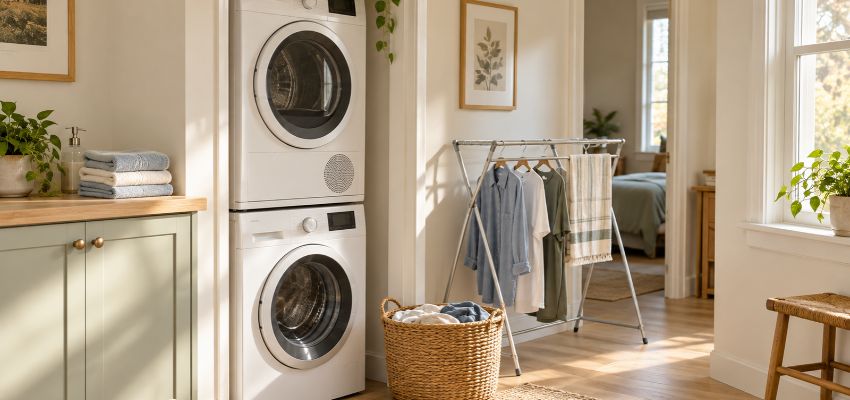
The right compact laundry appliances should fit both your home and the way you finish laundry. A washer that fits neatly into a corner can still leave you with repeated small loads, wet clothes waiting for space, or more hands-on work than you wanted.
Start with three questions: how much do you wash, when do you need it dry, and how often can you return to the machine? Those answers narrow the choice between a compact pair, an all-in-one combo, and a portable washer far more usefully than a small footprint alone.
Choose Around Your Laundry Week, Not Just Your Floor Space
| Your laundry week | Setup to consider | Trade-off to check |
|---|---|---|
| One modest load at a time | An all-in-one combo | No transfer; check the full wash-and-dry load and program. |
| Several loads on one laundry day | Separate machines, stacked when suitable | Loads can overlap; check height and access. |
| No permanent laundry location | A portable washer | Check permission, water, drainage, and the drying arrangement. |
| Frequent small washes with hanging space | A washer plus air-drying space | Check how many wet items can hang at once. |
These are starting points, not four exclusive categories. Compact describes size; stacked describes placement; an all-in-one combo washes and dries in the same drum; and ventless describes a drying system.
A compact pair can be stacked and use a ventless dryer. An all-in-one is not necessarily compact. Read the actual configuration rather than treating those labels as interchangeable.
Rule Out Setups Your Home Cannot Support
Make a short list of feasible setups before comparing conveniences. The most appealing cycle or smallest cabinet is of little use when the connections or working space do not suit the home.
Check Water, Drainage, Power, and Rental Permission
Confirm what the machine needs and what the home provides: the specified electrical supply, a suitable water connection, and an approved drain arrangement. For a rental, establish whether the proposed installation or portable use is permitted before ordering.
A portable washer can still require a compatible faucet connection and a secure drain hose. Some models allow different filling methods, but “portable” does not promise that any sink or bucket arrangement will work.
Read the exact model’s installation instructions, including drain height and hose routing, rather than copying another owner’s setup.
Measure Door Openings, Hose Space, and Your Reach
-
The delivery route
Measure entrances, turns, and the final opening. Include any packaging or handling requirements that the delivery service specifies.
-
The installed machine
Allow the model’s required rear, side, and upper clearances, plus room for connections. Cabinet depth alone does not tell you the installed depth.
-
The movements you repeat
Check the open door or raised lid, access to filters and tanks, and room to load a basket. For stacked machines, check that the controls and dryer drum are comfortably reachable.
Manufacturer sizing instructions help identify the measurements to collect. Use the installation drawing for the model you shortlist to settle the final clearances; a general size chart is only a first filter.
Choose a Combo for Fewer Transfers; Separate Machines for Overlapping Loads
The useful comparison is not simply one appliance versus two. It is whether you want one load to proceed without a transfer or need several loads to move through the day.
A Combo Keeps One Load Moving Without a Transfer
An all-in-one can wash and dry a suitable load in the same drum. That removes the usual transfer between machines, which can matter when you are busy elsewhere or find lifting wet laundry difficult. It still needs loading, unloading, and the maintenance specified for that model.
Check the load allowed for the full wash-and-dry program, not just the largest wash-only figure. Some programs or machines permit less laundry for drying; others are designed to wash and dry the same rated load.
Follow the specific limit rather than assuming every combo needs half its laundry removed.
Separate Machines Let the Next Wash Start While Clothes Dry
With two machines, the washer becomes available once its load moves to the dryer. You do need to make that transfer, but you can then wash another load while the first dries. The benefit matters most when your basket contains several separate loads.
Consider a hypothetical laundry day with a clothes load, a towels load, and bedding. One shared drum handles the wash-and-dry sequences in turn. With separate machines, part of the work can overlap after the first transfer.
This explains the workflow advantage without promising a particular finish time: actual cycles, fabrics, and drying settings still determine the schedule.
The choice between a combo and separate machines should therefore reflect your busiest ordinary laundry day. A single load that runs without intervention and several loads finished in one evening are different priorities.
Good Housekeeping’s expert comparison also distinguishes transfer convenience from the ability to run two machines at once.
Stack Two Machines When Floor Space Is Tight and Height Is Available
- Use vertical space Stacking a compatible washer and dryer reduces the width needed compared with placing that pair side by side. It does not automatically use less floor area than one all-in-one.
- Keep the two-machine workflow You still transfer wet clothes, and washing can overlap with drying. Stacking changes placement; it does not turn the pair into one shared drum.
- Check compatibility and access Use the approved stacking arrangement and kit for the machines. Check the final height, controls, loading access, and maintenance access before committing.
Comparing stacked machines and a combo means comparing the whole usable space. The spare height above an all-in-one may be valuable for storage, while a stacked pair may better suit repeated loads.
Neither advantage helps much if you cannot comfortably reach or load the upper machine.
Size the Washer for Your Regular Loads – and Plan for Bulky Bedding
Capacity is useful only when it matches the things you actually wash. Household size gives a rough starting point, but work clothes, towels, fabric weight, and washing frequency can change the job considerably.
Smaller Loads Work When You Can Wash More Often
A compact washer can suit someone who washes manageable loads throughout the week. The same capacity can become frustrating when all the laundry must wait until one afternoon. Estimate the number of separate loads you would accept, including any sorting you already do.
Before choosing between compact and full-size washers, look at a normal week’s laundry rather than the fullest basket you can imagine.
Check loading instructions and permitted items. Drum volume, a dry-weight rating, and a retailer’s “family size” description are not interchangeable measures.
Keep a Separate Plan for Items the Drum Cannot Handle
A bulky comforter can be a different problem from a pile of shirts, even when their weights look similar. Check the item’s care label and the machine’s bedding guidance; do not assume an item is suitable just because it can be squeezed through the door.
An occasional visit to a larger machine may be a reasonable compromise when a compact setup handles the rest of the year’s laundry.
When bulky bedding is a frequent part of the routine, however, that repeated trip belongs in the comparison. Decide which inconvenience you would actually be willing to repeat.
Choose a Portable Washer Only When Setup and Drying Fit Your Day
Portable machines can reduce trips to shared laundry, but some of that saved travel becomes work at home. Count moving the machine, connecting or filling it, securing the drain, transferring wet items, and putting everything away. The balance depends on the model and how often you wash.
Count Usable Wash Capacity, Not a Combined Tub Total
For a twin-tub machine, check the washing compartment and spinning compartment separately. A headline number may combine the two ratings; it is not necessarily the amount that can be washed in one load. Use the manufacturer’s separate ratings and instructions to interpret the listing.
Understanding portable washer capacity also means counting repeat operations. When the spinner takes less than the wash compartment, one wash may need more than one spin batch. That affects how often you return to the machine even before drying begins.
Choose Twin-Tub for Manual Control; Check Single-Tub Automation
- Twin-tub
A typical semi-automatic twin-tub separates washing from spinning. You move wet laundry between compartments and manage the filling, rinsing, and draining steps required by that model.
- Single-tub
The same tub handles the washing and spinning functions. Some portable models automate the sequence, while other small machines still need manual filling or other intervention. Check what happens after pressing Start.
The difference between twin-tub and single-tub washers is most useful when described as a list of tasks you must do. Ask whether you can step away through washing, rinsing, and spinning, or need to return between stages.
A lower purchase price may be worthwhile to one household and too much recurring work for another.
Treat Spin-Drying as the Start of Drying, Not the Finish
A spin function extracts water; it does not by itself provide heated tumble drying. Do not interpret “washer and dryer” in a listing as proof of a heat-drying cycle. Confirm the drying mechanism and what condition the clothes are expected to be in afterward.
The space to air-dry clothes at home is part of a portable setup. Picture the towels and shirts hanging at the same time, including the next load that may arrive before they are dry.
A washer can be easy to store while its drying arrangement occupies the room for much longer.
Choose the Drying Method Before You Finalize the Setup
Resolve drying before ordering the washer or pair. A suitable drying arrangement determines where the machines can go and how soon the room – and the clothes – will be available again.
Vented Dryers Need a Suitable Exhaust Route
A vented dryer sends moist exhaust outdoors through the specified duct arrangement. Check whether an appropriate route exists and whether the model’s installation requirements can be met. A nearby window does not, by itself, establish an approved installation.
For an existing laundry location, confirm the condition and suitability of the connections rather than assuming any replacement dryer will work. For a new location, establish feasibility before buying; this is an installation decision, not an accessory to sort out after delivery.
Ventless Dryers Still Need Drainage and Filter Care
Ventless dryers do not need an outdoor exhaust duct, but they still have installation and maintenance requirements. Moisture removed from the clothes must be managed, commonly through a collection tank or a drain connection, depending on the machine. Check room conditions and required clearances too.
Conventional condenser and heat pump dryers are different technologies within the ventless category. Heat pump models recover and reuse heat; that distinction matters when comparing energy use and programs.
ENERGY STAR explains their water drainage and filter care. Avoid treating “ventless” as a promise of identical drying times or maintenance across models.
The choice between vented and ventless dryers should start with installation feasibility, then move to the programs and maintenance you would actually use.
Compare relevant model information instead of relying on a blanket claim that one entire category always dries faster.
Walk Through One Laundry Day Before You Buy
-
01Set out a realistic day’s loads
Separate the clothes, towels, and bedding you normally wash. Decide which items must be ready that day and which can wait.
-
02Follow each load through to dry
Mark every transfer, split spin batch, tank-emptying task, or hanging session. Check where wet items wait when the next stage is occupied.
-
03Check the room while laundry is in progress
Account for open doors, baskets, hoses, drying racks, and access to a shared sink. A setup must work during use, not only when everything is put away.
-
04Verify the shortlisted model
Use its installation instructions, program details, permitted loads, and maintenance requirements to check the assumptions in your proposed routine.
This is a planning exercise, not a prediction of cycle times. Use model-specific evidence for the final comparison.
Once the setup is settled, keep everyday laundry supplies suited to its instructions and load sizes. The detergent type and dose, a manageable basket, and somewhere for items that cannot tumble-dry should support the routine you have chosen.
Choose the setup that removes the part of laundry you most want to change: repeated trips, transfers, a crowded floor, or a backlog of loads. Keep the trade-off visible. The right small-space solution leaves you with a routine you can repeat comfortably – and a clear route from dirty laundry to dry clothes.
