
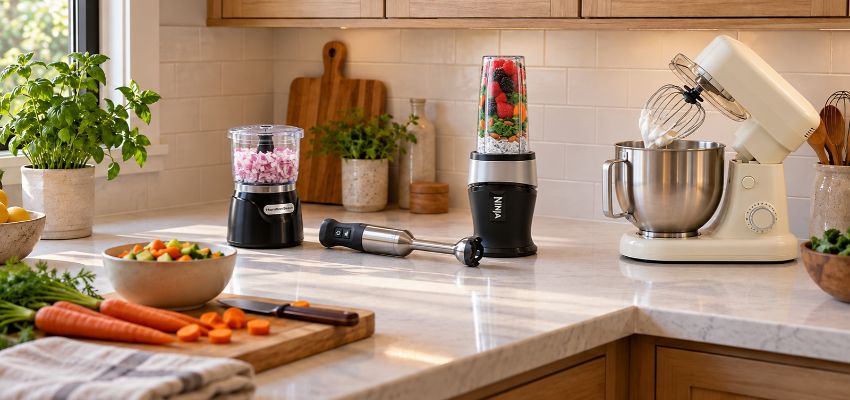
The food prep appliances worth your counter space are the ones that make a regular job easier, including the work of setting them up and cleaning them afterward.
A blender earns its place through the drinks you actually make. A processor earns it through repeated chopping, slicing, or shredding. A mixer earns it through the mixtures you regularly prepare. Start with that job, then choose the size and layout that fit your kitchen.
This overview covers blending, chopping, processing, and mixing. Cooking appliances belong in a separate decision, although they compete for the same stretch of counter.
Choose the Appliance for the Food You Make Most
- Smoothies and blended drinks → blender
A useful starting point for smooth, pourable mixtures. Check the specific model for frozen ingredients and ice; the category name alone does not establish those capabilities.
- Soup in its cooking pot → immersion blender
Blends directly in a suitable container, reducing transfers. Temperature, container depth, and cookware compatibility still matter.
- Small amounts of chopped ingredients → mini chopper
A compact option for tasks such as chopped onion, herbs, and small batches of sauce. A chopping blade does not replace a slicing or shredding disc.
- Repeated slicing and shredding → food processor
Look for the actual discs and feed-tube arrangement needed for your ingredients. Extra functions may require separately sold accessories.
- Whipping and mixing → hand or stand mixer
Choose around the mixture and how long you need to work it. Neither a large bowl nor a high wattage number establishes a machine’s dough capacity.
The useful distinction between a processor and blender is the result you need: ingredients cut into pieces, or ingredients blended into a smoother mixture.
For example, a smoothie and shredded cabbage for slaw call for different tools, even though both start with produce. KitchenAid’s function comparison also distinguishes chopping from disc-based slicing and shredding, with capabilities varying by model.
Match Your Blender to Your Drinks and Cooking
Begin with your usual recipe and the amount you make at once. The blender that suits one breakfast drink may be awkward for several servings, while a large pitcher may be unnecessary for a small dressing.
Choose a Personal Blender for Individual Drinks

A personal blender makes sense when your routine centers on one drink at a time and its cup fits that portion. Check whether the blending cup also works as your drinking container, which parts need washing, and where the lid and blade assembly will dry.
The choice between personal and full-size blenders changes when you routinely make drinks for several people.
A larger pitcher may reduce repeated loading and blending; individual cups may still be convenient when everyone wants a different recipe. Count the full sequence rather than assuming the smaller appliance always means less work.
Choose an Immersion Blender for In-Pot Blending

An immersion blender is worth considering when soup or sauce is already in a suitable pot. You move the blending head through the food instead of transferring the whole batch to another vessel.
It can also suit a small dressing when the container and ingredient depth allow the head to work properly.
An immersion blender is convenient for those direct-in-container jobs, while a suitable countertop blender may better fit your regular frozen drinks.
The manufacturer’s blender comparison describes this difference in use. Check the model’s instructions for temperature, ingredients, and cookware; keep the head submerged as directed to control splashing.
Size the Jar for Your Usual Batch
Start with the amount of finished drink or sauce you normally need. Then check usable blender capacity against the marked fill limits for that recipe. The jar’s stated volume is not permission to fill it to the rim, and different preparations may have different limits.
-
Your normal portion
Compare your actual recipe with the permitted fill level. Include every ingredient, not just the liquid you pour in first.
-
Small-batch contact
Check instructions and recipe examples for small quantities. A large vessel is less useful when you repeatedly need to stop and scrape a tiny batch.
-
Serving and washing
For several drinks, compare one pitcher with repeated cup batches. Include cups, lids, blade assemblies, and space to dry them.
Start Small for Chopping; Go Larger for Slicing and Shredding
For solid ingredients, the next question is whether you need smaller pieces or a specific cut. Chopping onion for a sauce and producing slices for a gratin are different jobs. Choose the mechanism before choosing the bowl size.
Use a Mini Chopper for Small Prep Jobs
A small bowl can suit a little onion, a handful of herbs, or a modest batch of pesto. Work in pulses when the instructions call for them, and check the texture between pulses. Continuing to run a chopping blade can take a mixture past the texture you wanted.
A small food chopper may be enough when your regular work stops at chopping, mixing, and puréeing small amounts.

It is a different proposition from a processor with a feed tube and discs. Before buying the larger appliance, name a task those extra parts would perform in your kitchen.
For dips and sauces, the mini processor or blender decision also depends on texture and how the ingredients move around the blade.
A spoonable, textured mixture and a pourable dressing are different targets. Check recipes and minimum quantities for the model rather than treating every small motorized bowl as interchangeable.
Choose a Full-Size Processor for Repeated Larger Jobs
A larger processor becomes more useful when you regularly handle enough food to make repeated small batches inconvenient, especially when slicing or shredding is part of the job. Think of cabbage for slaw, vegetables for several meals, or ingredients that need a disc rather than a chopping blade.

Choosing mini or full-size is therefore about both workload and function. Check the included accessories before comparing prices: a model pictured with several attachments may be sold in different bundles.
Identify the disc you need, how ingredients enter it, and where the finished food collects.
Choose Processor Capacity by Batch, Not Household Size
-
Start with your usual batch
Write down what you process in one session: a small sauce, vegetables for dinner, or ingredients for several meals. Household size alone does not describe that workload.
-
Check limits for the actual food
Look separately for liquid limits, chopping quantities, and any dough restrictions. A bowl’s stated cup size does not establish the permitted amount of every mixture.
-
Check loading and emptying
Compare the feed opening with the ingredients you use. Include any cutting needed before loading, the number of times you must empty the bowl, and access for scraping it out.
For example, two households of four might need very different machines. One mostly makes small sauces; the other regularly shreds vegetables for several meals.
Their food processor size should follow those batches, with enough practical room to work rather than an automatic “family of four” recommendation.
A larger bowl can reduce batch changes, but it also needs somewhere to be washed and dried. A smaller bowl may be easier to handle, but repeated loading can cancel that convenience. Compare the batch you usually make, then check the occasional larger recipe as a secondary need.
Choose a Stand Mixer for Work You Regularly Repeat
- Hand mixer
A compact choice for suitable lighter mixtures when you are comfortable holding and moving the appliance. It can work in different appropriate bowls and is easier to tuck away between sessions.
- Stand mixer
Worth considering for repeated mixing that is lengthy, heavier, or tiring to hold by hand. Choose a model rated for the recipe and batch; a larger bowl does not guarantee adequate capacity for every dough.


The hand or stand mixer choice becomes clearer when you picture the whole recipe. Whipping cream occasionally creates a different workload from regularly mixing stiff dough.
KitchenAid’s mixing comparison explains the distinction between holding a hand mixer and using a fixed-bowl machine for longer or heavier work.
- Using a heavy machine without lifting it out for every baking session.
- Keeping the bowl and controls accessible during a longer recipe.
- The machine occupies space between uses.
- The head or bowl needs room to move, and accessories need their own storage.
Before placing a stand mixer beneath an upper cabinet, check that you can add ingredients and remove the bowl and attachments comfortably. A tilt-head model also needs clearance above it when the head is raised.
Count Setup and Cleanup Before Adding Another Motor
Processing speed is only one part of convenience. A machine may save cutting effort yet add assembly and washing; another may be worth using because it reduces tiring hand movements, even when the total time is similar.
Compare Manual Effort with the Whole Electric Routine
Compare electric and manual choppers using a complete ordinary task.
Include getting the tool out, cutting food to fit, assembling it, processing, emptying, washing, drying, and putting it away. For a small garnish, those surrounding steps may dominate. Repeated larger jobs can change the balance.
Also identify what “manual chopper” means. A press-through grid is designed around a particular cut; a pull-cord model uses rotating blades. They require different motions and leave different parts to clean. Neither is automatically the lower-effort choice for every ingredient or every pair of hands.
Check the cleaning instructions before buying. A dishwasher-safe bowl does not mean every lid, gear housing, blade assembly, or motor unit belongs in the dishwasher. Look at the parts separately, including any brush or careful hand cleaning needed around sharp edges.
Add a Second Appliance for a Different Recurring Job
Ask what your current appliance cannot do satisfactorily. Daily smoothies and repeated disc-based vegetable prep can justify two different machines. A second machine that only repeats an occasional job needs a more convincing reason, particularly if reaching it makes the first machine harder to use.
A shared-base kitchen system may reduce the number of motor bases, but its pitcher, processor bowl, lids, and accessories still need space. Lay out everything you expect to keep. Compatibility, changeover, and washing matter alongside the advertised function count.
Optional stand-mixer attachments deserve the same check. They can add useful capabilities when you have a real task for them, but they also add purchase cost, assembly, and storage. Decide around the job you repeat, not the collection you might someday build.
Measure Working Space Before Choosing a Permanent Spot
-
Mark the base and operating clearance
Use the manufacturer’s dimensions to mark the footprint. Then check lid removal, feed-tube loading, head movement, and any clearance required by the instructions.
-
Leave room to load and unload
Keep usable space for ingredients and a bowl or cutting board. Confirm that you can lift off a full pitcher or processor bowl without awkwardly reaching around another appliance.
-
Find a home for removable parts
Allocate space for discs, lids, beaters, cups, and cords. Include drying space after washing; an accessory stored somewhere inconvenient can turn a useful function into one you rarely use.
-
Check the route from storage to use
Consider the machine’s weight, handles, shelf height, and access to a suitable outlet. A compact appliance is not convenient if retrieving it requires moving several other items.
-
Compare the space with your cooking routine
Your countertop cooking appliances share this workspace. Keep room for the meal’s next stage and follow each appliance’s operating clearances rather than placing machines tightly together.
Try the proposed location during an ordinary meal before committing to it. Leave the marked area occupied while you chop, cook, and wash up. You will see whether the machine belongs there or would work better on an accessible shelf, brought out when needed.
Name the job first, choose the appliance category, and check your normal batch against the model’s limits. Then measure the space needed to operate it and account for the parts you will wash and store.
A permanent counter spot makes sense when easy access improves a routine you already have. For the next purchase, start with one specific frustration you want to remove. That gives you a much stronger buying decision than a longer list of functions.
