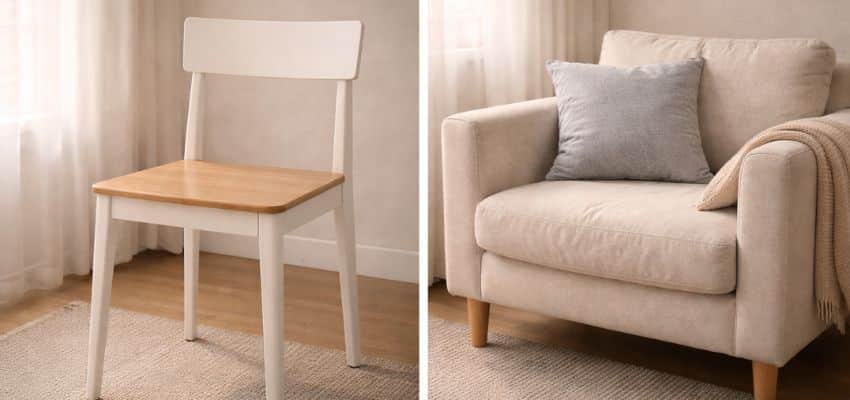
A larger sofa feels like an upgrade. A wider dining table suggests togetherness. A bigger fridge promises convenience, abundance, and ease.
On paper, these choices make sense. Bigger often signals improvement – more comfort, more value, more “grown-up” living.
Yet in daily life, the experience is often different.
Rooms start to feel tighter, not more generous. Moving around the house requires small adjustments – turning sideways, stepping carefully, rearranging your body to accommodate objects that never quite settle into the space. Even when the home looks tidy, something feels heavy and restrictive.
This quiet discomfort is easy to dismiss. Many people assume they just need better organization, stronger cleaning habits, or more time to “get used to it.” But the issue isn’t personal failure or poor styling.
The truth is simpler and more uncomfortable: bigger household items rarely make a home feel better to live in.
Bigger items change how a space feels, not just how it looks
At first glance, size seems like a visual issue. We notice whether a room looks spacious or crowded, balanced or heavy. But the deeper impact of large household items shows up not in how a space looks, but in how it feels to be inside it.
Even with only a few pieces, oversized items can alter perception and movement in ways that slowly make a home feel uncomfortable – without ever appearing messy or obviously wrong.
Visual pressure builds faster than we expect
Large items create a sense of visual weight almost immediately.
A big sofa, a wide cabinet, or an oversized dining table doesn’t need companions to feel overwhelming. Even on its own, it can make a room feel heavy, crowded, and visually full.
The eye has fewer places to rest, and the space feels “occupied” even when the number of items is small – much like the quiet tension created by constant background sound
This is why people often describe their homes as feeling heavy or too full, despite owning very little. The issue isn’t quantity – it’s scale.
Large objects reduce perceived freedom of movement
Beyond what the eye sees, the body feels size even more clearly.
Large household items change how you move through a space. You sidestep instead of walking straight. You rotate your body to pass through narrow gaps. You instinctively avoid certain paths because they feel tight or awkward.
Over time, these constant micro-adjustments create a subtle sense of being boxed in – the feeling of being slightly trapped inside your own home. The discomfort isn’t dramatic, but it’s persistent, and it shapes how relaxed or tense you feel without you consciously noticing why.
Too much furniture” doesn’t always mean clutter
Many people describe their homes as having “too much furniture,” even when everything is clean and neatly arranged. What they’re often reacting to isn’t messiness, but a form of overload created by size rather than disorder.
This is where clutter and scale quietly get confused.
A few oversized items can feel like overload
A room doesn’t need to be filled with objects to feel overwhelming.
One oversized couch, a bulky storage unit, or a large dining table can dominate visual space, block sightlines, and absorb attention. These items occupy not just physical room, but mental space as well. Even with very few belongings, the room can feel visually full, as if there’s no margin left.
This is why people often say their living room feels like “too much,” even when the number of items is clearly small. The overload comes from proportion, not quantity.
Why homes can feel messy even when they’re organized
A common frustration sounds like this: “It’s clean, but I still feel overwhelming.”
In many homes, the discomfort comes from how everyday items subtly reshape the space around them.
When furniture is larger than what the room comfortably supports, the home asks for constant micro-adjustments – where to step, how to pass, how to position your body – even though everything is technically in order.
Over time, this quiet tension mirrors the way the shape and limits of a home silently influence what feels like a “reasonable” purchase, making rooms feel heavier without adding a single extra item.
In these situations, organizing better doesn’t remove the discomfort, because the root problem isn’t clutter – it’s scale.
Big household items come with invisible daily costs
Large items often feel like a one-time decision. You buy them, place them, and assume the impact is done. In reality, their cost shows up quietly in daily life – through effort, sensory load, and reduced flexibility. These are not technical problems, but lived ones, repeated every single day.
They are harder to clean, move, and maintain
Big household items are physically demanding.
They’re heavier to shift when cleaning. Awkward to reach around. Difficult to move without planning, tools, or help. What should be small, routine actions – vacuuming, wiping surfaces, adjusting layout – become tasks you postpone or avoid.
Over time, this friction adds weight to everyday life. The item itself isn’t broken or low-quality, but it becomes hard to live with simply because it resists easy care.
They amplify noise, heat, and sensory fatigue
Larger appliances and fixtures tend to create more sensory presence.
They hum louder. They vibrate more. They radiate more heat. Even when operating normally, they occupy more of your auditory and physical awareness. This constant background stimulation contributes to subtle fatigue, especially in spaces meant for rest.
The home may still function well, but it no longer feels quiet or gentle. Sensory load increases without you consciously noticing why.
They lock your space into fewer possibilities
Once a large item is in place, options disappear.
Rearranging feels unrealistic. Adapting the room to a new routine feels costly. As life changes – working from home, hosting less, needing more flexibility – the space struggles to keep up.
The item anchors the room to a specific version of life. What once felt like a solid, future-proof choice slowly limits how the home can respond to change.
Bigger often feels better in theory, not in daily life
Bigger household items are rarely chosen by accident. They’re bought with good intentions and familiar logic: bigger feels like an upgrade, a sign of progress, something more adult and future-proof.
In theory, these choices promise convenience and comfort. In daily life, they introduce repetition, fatigue, and quiet regret.
What looks impressive on a spec sheet or in a showroom often feels different when experienced every day. Larger items demand more attention, more effort, and more accommodation than expected. The benefits show up occasionally, while the drawbacks repeat constantly.
This is where many people get stuck – confusing scale, power, or presence with a better lived experience. The same misunderstanding appears when people focus on specifications instead of how something actually feels to use, a pattern explored in mistaking added features for a better everyday experience.
The disappointment doesn’t come from choosing “wrong” items. It comes from trusting abstract improvements over lived reality.
What actually makes household items feel better to live with
If bigger doesn’t reliably improve daily life, the question shifts. Comfort isn’t about presence or impact, but about how quietly an item fits into the rhythm of the home. What feels better is often less visible, less demanding, and easier to forget.
Scale that matches the room and the routine
An item can technically fit a room and still feel wrong.
What matters is whether its size matches how the space is actually used. A table that leaves room to walk naturally, a sofa that doesn’t dictate traffic flow, an appliance that supports the pace of daily routines without getting in the way.
When scale aligns with both space and habit, the home feels cooperative rather than constraining.
Objects that leave mental and physical breathing room
Comfort comes from what an item doesn’t take.
Items that don’t dominate attention allow the eye to rest and the body to move freely. They don’t demand constant awareness or adjustment. This breathing room – both visual and physical – is what allows a space to feel calm, even when it’s actively used.
Choosing ease over presence
Many objects are chosen to be seen. Fewer are chosen to be lived with.
Items that feel good over time prioritize ease: easy to move around, easy to maintain, easy to adapt as life changes. They don’t need to impress. They simply support daily life without asking for anything in return.
Conclusion
A comfortable home isn’t defined by large furniture or powerful appliances. It’s shaped by how much room everyday life is given to unfold.
What makes a space feel good isn’t size or presence, but restraint – objects that know when to step back and leave space for living.