
A drawer full of gadgets does not make dinner prep easier if the knife is awkward, the board slides, or there is nowhere to toss chopped vegetables. The most useful kitchen prep tools are the ones that make your usual meals easier to prepare – not the ones that appear on every essentials list.
Start with the work you repeat: cutting, measuring, mixing, rinsing, draining, and opening ingredients. Then decide what deserves space in your kitchen.
Identify the Prep Tools Your Usual Meals Actually Require
-
List three meals you actually cook
Use a normal pasta night, salad, soup, or another familiar meal—not a hypothetical recipe.
-
Write down the prep tasks for each meal
Separate cutting, measuring, mixing, rinsing, draining, and opening ingredients. Notice the jobs that recur.
-
Check which tools already handle those jobs
Keep what works. Identify a missing tool only when a repeated task is awkward, unsafe, or unnecessarily time-consuming.
A useful kitchen prep setup follows your routine, not a universal gadget count.
For many home cooks, a workable starting point is one comfortable main knife, a stable board, basic measuring tools, a mixing bowl, and a way to drain food. A peeler, can opener, whisk, or grater earns its place when your recipes use it. You do not need every item on day one.
Name the meal, the task, and the problem. “I need a tool to drain pasta without losing noodles” is a better reason to shop than “every kitchen should have this gadget.”
Get the Cutting Basics Right Before Adding Gadgets
Choose One Knife for Most Everyday Chopping
If you regularly dice onions, slice carrots, and cut herbs, begin with a knife that feels controlled in your hand. A chef’s knife and a santoku can both handle everyday chopping, although their blade shapes and cutting motions differ.


Choose the one you can guide comfortably rather than assuming either style is universally better.
Kitchen shears are a supplement, not an automatic replacement for a main knife. Shears are handy for snipping herbs and opening packaging, while a chef’s knife remains more versatile for chopping vegetables. You do not need a large knife set to solve one uncomfortable task.
Make Your Cutting Board Stable and Comfortable to Use
A board that moves under pressure makes even simple chopping frustrating. A damp towel or nonslip mat can help stabilize a sliding cutting board. Leave enough room for both the ingredient and the cut pieces.
If you are replacing a board, wood and plastic cutting boards require different care routines; choose a surface you can clean and maintain consistently.

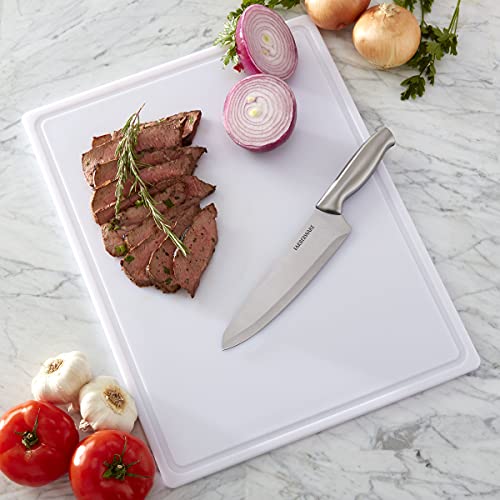
Also, a practical cutting board size leaves room to chop without crowding the counter. Check the footprint you can use and store.
Measure Ingredients With the Tools Your Recipes Require
Measuring spoons handle small amounts of seasonings and liquids. Dry and liquid measuring cups serve different measuring tasks: dry cups allow leveling ingredients at the rim, while liquid cups allow a fluid level to be read without filling to the brim.
A liquid measuring cup with a clear scale is a practical example: you can pour, check the level, and adjust without transferring the ingredient.
The OXO angled design shown below adds markings that can be read from above; that feature is helpful only if it solves a real annoyance in your routine.

If you bake recipes that provide weights, a kitchen scale can help measure flour more consistently than volume cups. For everyday savory cooking, begin with what your recipes actually ask you to measure.
Choose a Mixing Bowl That Leaves Room to Work
A bowl is not just a place to hold ingredients. You need room to toss salad, coat vegetables, mix a marinade, or combine a batter without spilling over the rim. One medium-to-large bowl that fits your common portions can do more work than several tiny bowls that look tidy in a cupboard.
Before adding a nesting set, check whether your current bowl is too small, heavy, unstable, or difficult to store. The right mixing bowl size leaves room to stir or toss your usual portions without spilling.
Materials matter too: stainless steel, glass, and plastic bowls offer different handling and cleaning trade-offs. Choose by the tasks you repeat.
Match Rinsing and Draining Tools to the Ingredient
Colander or perforated strainer
Larger openings drain pasta and washed vegetables quickly. Check that the basket fits the sink and stands securely.
Fine-mesh strainer
Closely woven mesh retains smaller grains and catches finer particles, but can drain more slowly and requires thorough cleaning.
If your main task is draining pasta or rinsing larger produce, the three-quart OXO strainer below illustrates a freestanding perforated option.
Its raised feet help keep the basket off a flat surface. A colander with larger holes suits pasta, while fine mesh retains smaller grains; match the openings to the food rather than assuming one strainer handles everything.

If you wash leafy greens often, drying them is a separate job. A salad spinner can remove excess water from frequently washed greens before dressing them, but it is not essential for an occasional salad.
Add Small Prep Tools Only When a Repeated Task Justifies Them
Small prep tools can save effort, but they also accumulate quickly. Instead of treating them as a required checklist, consider the friction they remove.
Opening, Peeling, and Grating
If canned beans or tomatoes are regular ingredients, a dependable can opener matters more than novelty gadgets. Manual and electric can openers have different handling trade-offs: a manual model takes hand effort and little space, while an electric model may help someone who struggles with grip. A peeler earns space if you peel produce often.
A grater earns space when you regularly grate cheese, zest citrus, or shred vegetables. A fine rasp and a box grater suit different grating jobs: a rasp makes fine zest and shavings, while a box grater provides broader shredding surfaces. You may not need both.
Slicing, Crushing, and Mashing
Uniform thin slices may be quicker with a mandoline, but its sharp blade adds a safety and cleaning trade-off. A mandoline makes repeated thin slices more uniform than many knife cuts, provided you use its guard and handle it carefully. If you rarely make such cuts, a knife may be enough.
For garlic, a garlic press may save effort when you crush several cloves, though cleanup can outweigh the benefit for occasional use.
For potatoes, a masher gives a more rustic texture while a ricer makes finer pieces. Choose by how often you prepare the dish and the texture you want.
Know When an Appliance Saves More Work Than It Adds
For one onion and a handful of herbs, chopping by hand may finish before you assemble and wash a food processor.
For several batches of vegetables, the calculation changes: count assembly, processing, transferring, washing, drying, and storage – not just the seconds the motor runs.
Do not treat a food processor as a baseline kitchen prep tool. A food processor may help with large batches, while hand chopping can be faster for small jobs once assembly, washing, drying, and storage are counted. The task and quantity – not the appliance’s advertised speed – should guide the decision.
Check Your Current Setup Before Buying More
Open your drawers and cabinets before opening a shopping tab. Put the tools you actually use for three typical dinners on the counter. Notice which task slows you down, which tool is uncomfortable, and which item is difficult to clean or store. A replacement should solve one of those problems.
-
Frequency
A tool should earn space through repeated use, not one imagined recipe.
Look forA job you do in several meals each week.AvoidA gadget you might use once a year. -
Function
The purchase should solve a specific problem your current tools leave unsolved.
Look forA clear task such as draining pasta or measuring liquids.AvoidA second tool that duplicates what you already own. -
Handling
Comfort and control matter as much as features.
Look forA secure grip, stable position, and straightforward cleaning.AvoidAwkward handles, slippery bases, or hard-to-reach crevices. -
Space
A tool must fit both your counter and your storage routine.
Look forA footprint and storage shape that work in your kitchen.AvoidBulky equipment that blocks everyday essentials. -
Trade-off
Include setup and cleanup in any promise of speed.
Look forA real reduction in effort across the whole task.AvoidA shortcut that takes longer to assemble and wash.
A sliding board deserves attention before a specialty slicer. A bowl that spills every time you toss vegetables may be a better upgrade than a second grater. And if a tool only looks useful for a recipe you have never made, leave it on the wish list until the need becomes real.
Start with the jobs you repeat, make the core cutting and measuring tools comfortable to use, and add specialized equipment only when it removes a recurring obstacle. A thoughtful prep setup is not a complete collection; it is the collection that helps you get dinner started without unnecessary clutter.
